
CANAL SYSTEM IN SYCON SPONGE
SYCON SPONGE-CANAL SYSTEM : Structure, Function, and Biological Significance

Sycon (Wikipedia) is a sedentary sponge (phylum Porifera). It leads an aquatic life The body of sycon shows pores and canals which form a complex canal system. It is called sycon type of canal system. It is useful to draw water current inside the body. These water currents bring in food and oxygen. The body wall of sycon contains outer dermal layer and inner choanoderm. in between these two layer mesenchyme is present. The body wall is folded regularly and develop a regular canal system.
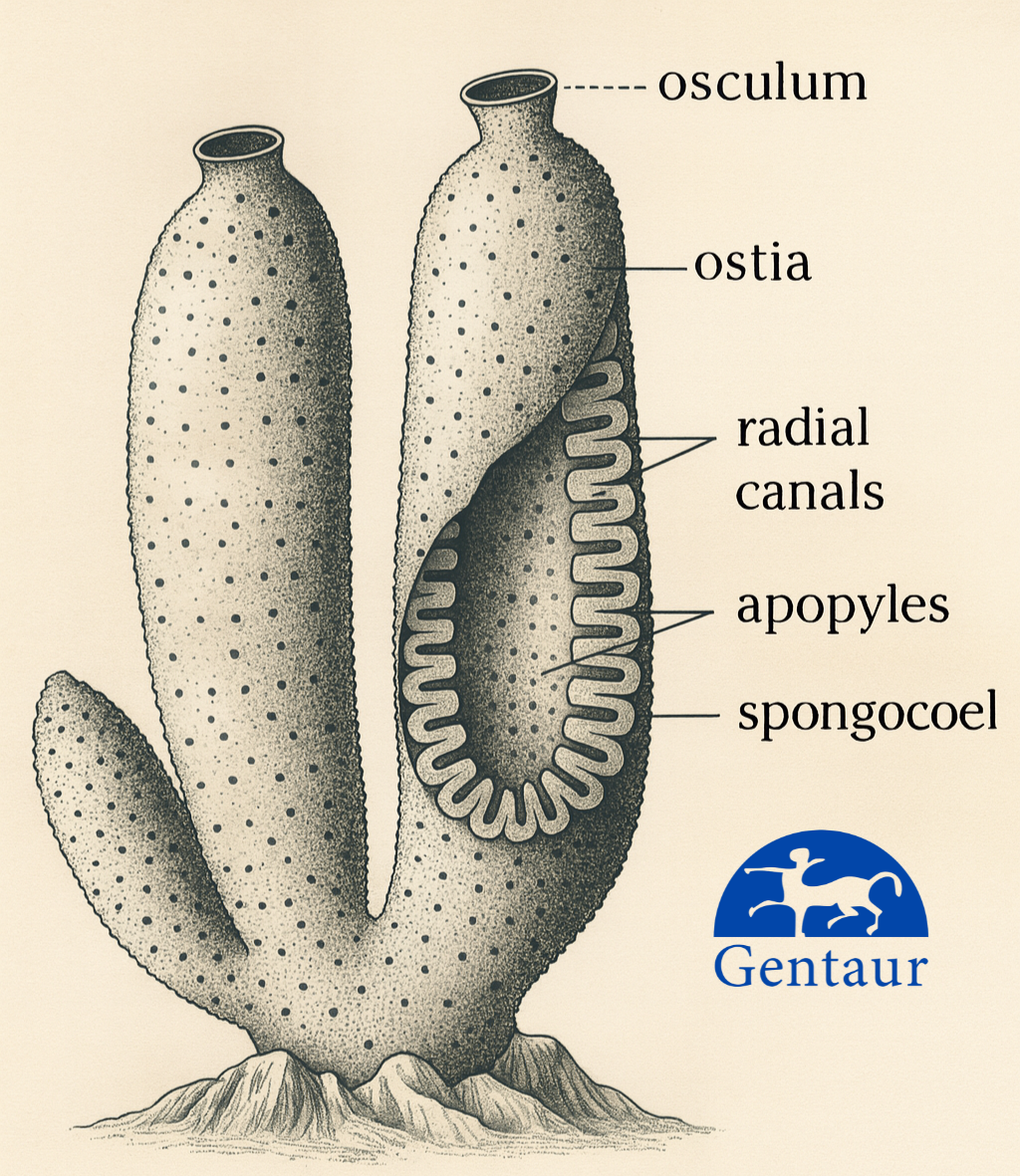
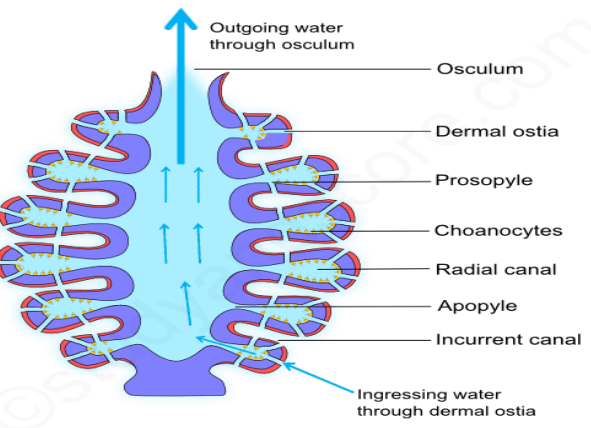
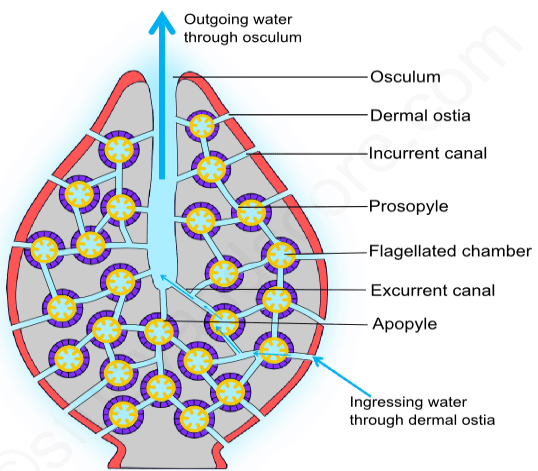
1) Ostia : The body wall is folded. In between two folds an incurrent canal is present. The opening of incurrent canal shows a pore membrane. This will show one or two ostia, through which water enters into the incurrent canals. The ostium is surrounded by myocytes. These amoebocytes will work as sphincters. They can close these openings or open them to regulate the inflow of water.
2) Incurrent canals : In between two folds of the body wall an incurrent canal is present. These canals end blindly towards inside. This is lined inside by pinacocytes. These are flat cells and are contractile.
3) Prosopyles : The incurrent canal opens into the radial canal through prosopyles'.
4) Radial canals: In between two incurrent canals a radial canal is present. It ends blindly to the exterior. It leads into excurrent canal internally.
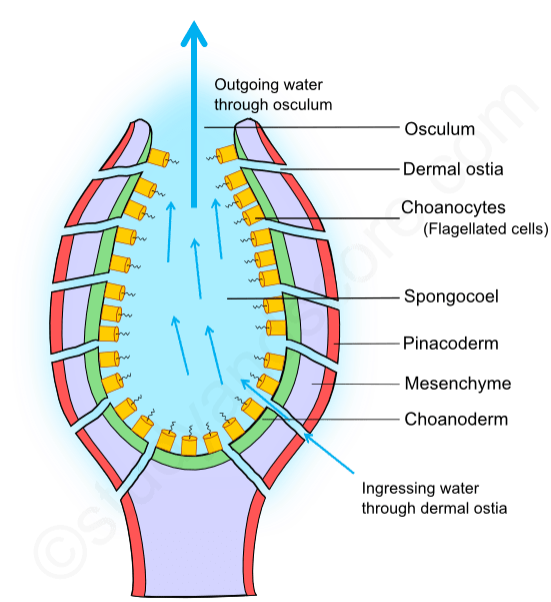
Radial canal is lined with choanocytes or flagellated cells. Hence these chambers are called flagellated chambers.
5) Apopyle : Radial canal opens into excurrent canal through an opening called apopyle. The apopyle is also surrounded by Myocytes.
6) Excurrent canal: It is short and wide chamber. It opens into spongocoel. This canal is lined with flat epithelial cell like the spongocoel. The board opening between excurrent canal and sponogocoel is also called internal ostium.
7) Spongocoel: The central part of the cylinder of sycon will show a hollow cavity called spongocoel. it is lined with epithelial cells. At the apex it opens out through osculum.
Because of the action of flagella of choanocytes water is drawn into the body. This is called incurrent water. This brings in food and oxygen. Hence it is called nutritive current. The water that goes out of the osculum is called excurrent water.
Functions of Sponge Canal System :
1) It brings constant supply of water into the body and helps in respiration.
2) Water brings with in small food particles which are used by the sponge
3) It helps in the process of reproduction.
4) It helps in the process of discarding waste matter out of the body.
- Feeding and Respiration :
The constant flow of water brings in oxygen and food while removing waste products, helping the sponge survive in its aquatic environment. - Nutrient and Gas Exchange :
As water passes through the radial canals, choanocytes trap food particles and engage in gas exchange. This mechanism is a passive yet effective way for the Sycon to acquire nutrients and oxygen. - Reproduction :
The water flow system aids in the reproductive process by facilitating the movement of gametes (sperm and eggs) in species that reproduce sexually. - Waste Removal :
Water exiting through the osculum carries with it metabolic waste, effectively maintaining homeostasis within the sponge.
How Water Flow Works in Sycon Sponges ?
Water flows through a well-structured sequence:
- Ostia → Incurrent canals → Prosopyles → Radial canals → Apopyles → Excurrent canals → Spongocoel → Osculum
This movement of water is driven by flagellated choanocytes which beat rhythmically to draw in water, trapping food particles and expelling waste. This water flow mechanism is crucial for feeding, respiration, and waste removal.
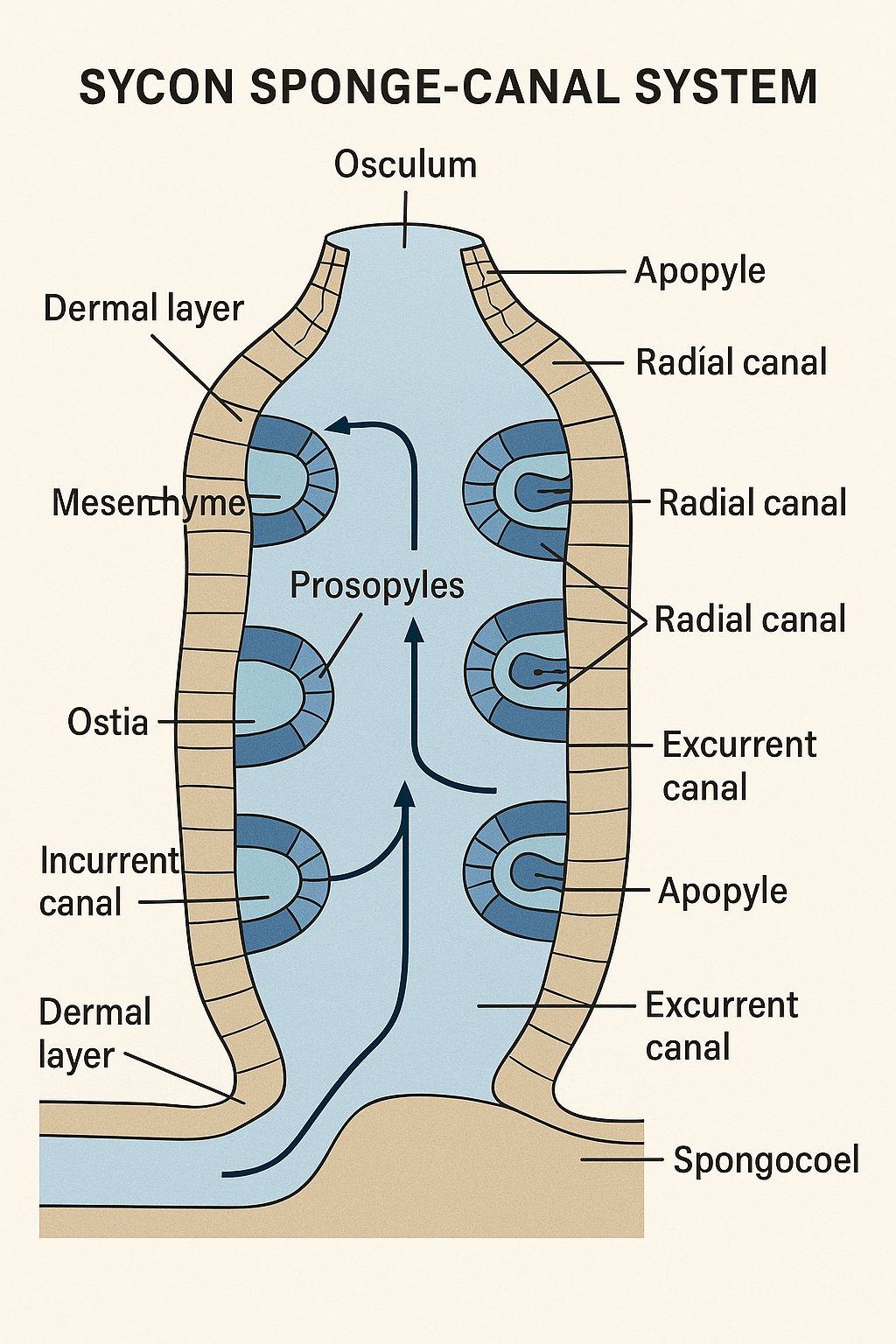
This unidirectional water current is maintained by flagellated choanocytes, which beat rhythmically to draw water in and expel it. This mechanism is crucial for feeding, gas exchange, and removal of metabolic wastes.
The Sycon canal system is a remarkable example of evolutionary efficiency in aquatic filter feeders. Its folded body wall and structured canal flow facilitate key processes like feeding, respiration, and excretion in a passive yet highly effective manner. As a model organism in marine biology, Sycon continues to provide critical insights into early multicellular life and Porifera physiology.
The Biological Significance of the Sycon Canal System
The Sycon canal system is an example of evolutionary efficiency in action. By utilizing a passive filtration system, Sycon sponges can effectively perform essential biological functions without complex organ systems. This efficiency provides crucial insights into the evolution of multicellular organisms, particularly in the context of early life forms in aquatic environments. The simplicity of the canal system in Sycon is contrasted with the complexity seen in more evolved organisms, making it a valuable model in marine biology and porifera physiology.
In addition to its biological functions, the Sycon canal system is key for studying the development of multicellular organisms. It offers a window into how simple, specialized cells can organize into functional systems for feeding, gas exchange, and waste disposal, processes that are fundamental to the survival of more complex life forms.
Sycon Sponges as a Model Organism in Marine Biology
The Sycon sponge-canal system is a striking example of evolutionary design, where a simple yet highly functional canal network supports a variety of essential biological processes. It not only supports feeding and respiration but also provides valuable insights into the development of multicellular organisms. The folded body wall, choanocyte-driven water currents, and unidirectional water flow all contribute to its efficiency in an aquatic environment. By studying the Sycon sponge, researchers can gain critical knowledge into the early stages of multicellular life, offering a deeper understanding of Porifera physiology and marine ecosystems.
What is Sycon?
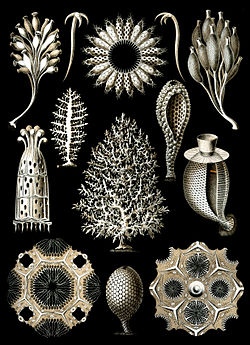
Sycon is a calcareous sponge belonging to phylum Porifera. It is commonly studied as a classic example to understand the canal system in sponges, especially the sycon type canal system (also called the syconoid canal system).
Canal System in Porifera
The canal system in Porifera is a water circulation system that helps in feeding, respiration, excretion, and reproduction. The water canal system is a defining feature of sponges and is found only in this phylum. Based on complexity, the canal system of sponges is divided into:
- Ascon type canal system
- Sycon type canal system
- Leucon type canal system
Sycon Type of Canal System
The sycon canal system represents an intermediate level of organization between the asconoid canal system and the leuconoid canal system. Therefore, Sycon is often cited as a sycon type canal system example.
In the canal system of Sycon, the body wall is folded, increasing surface area and efficiency. This structure is best understood using a sycon diagram, sycon canal system diagram, or TS of Sycon diagram, which clearly shows the arrangement of canals.
Canal System Diagrams
Students often refer to:
- Canal system of Sycon diagram
- Sycon type canal system diagram
- Syconoid canal system diagram
- Canal system in sponges diagram
- TS of Sycon
- Diagram of Sycon
These diagrams are essential for understanding the structure of Sycon and are commonly asked in exams under topics like describe canal system in sponges or explain canal system in Sycon.
Comparison with Other Canal Systems
- Ascon type canal system: Simplest, found in small sponges
- Sycon type canal system: Moderately complex, found in Sycon
- Leucon type canal system / Leuconoid canal system: Most complex, found in higher sponges
This comparison helps explain canal system of Porifera evolution.
Function of the Canal System
The function of the canal system includes:
- Feeding through filtration
- Respiration and gas exchange
- Removal of metabolic wastes
- Transport of reproductive cells
Thus, the water canal system in sponges is essential for survival.
Sycon Characteristics and Classification
- Sycon classification :
-Phylum: Porifera
-Class: Calcarea
- Sycon characteristics include radial symmetry, calcareous spicules, and a well-developed sycon type canal system.
- Often referred to as Sycon sponge or Porifera Sycon in textbooks.
Importance in Biology
The sycon canal system is frequently used in biology education alongside topics such as:
- Canal system
- Phylum Porifera
- Structure of Sycon
- Water canal system is found in sponges
Because of its clarity and organization, Sycon is a standard model organism for understanding early multicellular organization.